Showing posts with label Pisco Elqui. Show all posts

Thursday, December 29, 2016

estrellas

(A few days ago…)
Alejandro picks us up as the golden hour is starting to fade in Pisco Elqui. Elqui Valley and the state of Coquimbo is the Ruta de las Estrellas: the route of the stars, because of its dry air and very clear skies. The biggest telescopes are to the north in the Atacama desert, but Elqui Valley has a bunch of smaller telescopes for research and for tourists.

We aren't going to any of these. Instead, we pull up to the very end of the dirt road, in a natural bowl created by the high mountains, some of them over 12,000 feet high. We're close to the Argentine border. I've circled Alcohuaz on the map below.
Jorge and Anita greet us, and Jorge makes a fire. Our eyes grow accustomed to the darkness. Jorge points out Venus and Mars. Then we look at a variety of constellations near and far through the telescope.
We're outside long enough to see the stars move, thanks to the earth's rotation. I get my best glimpse yet at the Greater and Lesser Magellanic Clouds, with the Southern Cross, the most famous of Austral constellations.

I've been looking at the stars through my skylight back at the hotel, and on 4 am walks to the bathroom a hundred yards away. The previous night I saw Jupiter, the brightest object in the sky. (I know this thanks to the Star Walk app on my phone, and wifi from the hotel pool bar.)

Years ago I took a 5-week astronomy class at the Academy of Science in Golden Gate Park. It was after hours, and we got to sit in the old planetarium, while Walt, the voice of the planetarium, taught us about the best-known constellations for each season. On the 5th week, we went to the Southern Hemisphere, the first time I had traveled south of the equator. I've since been below the equator many times, in New Zealand, Fiji, Tahiti, and Peru. But this is the brightest I've ever seen the Magellanic Clouds.

In English and Spanish, Jorge and Anita tell us the various myths of the constellations, from the indigenous Mapuche people to Greek and Lakota myths for the Pleiades. Orion, of course, is upside down in Chile. So are Castor and Pollux, the Gemini twins.

I see several shooting stars, gone before I'm even sure they were there, and wish fervently on them.

One cluster reminds me of a kaleidoscope. It's a pristine night. I tell Anita and Jorge about astronomy week at Bryce Canyon, which I happened upon this June. It turns out Anita has been to the United States—she spent a semester at University of Nevada: Reno! Long before she was interested in the stars. She agrees, Nevada felt like northern Chile.

I hope, Anita says, that the milky way is still here for my grandchildren. The ones that aren't born yet. I hope so too.


Adrienne Rich's Planetarium:
I am bombarded yet         I stand

I have been standing all my life in the   
direct path of a battery of signals
the most accurately transmitted most   
untranslatable language in the universe
I am a galactic cloud so deep      so invo-
luted that a light wave could take 15   
years to travel through me  

Tuesday, December 27, 2016

ferment

It's hard to miss Destilleria Pisco Mistral: it's opposite the square in a town that's only 4 or 5 blocks. Tour buses are parked in front. The next tour in English wasn't for an hour, so I joined a tour in Spanish. Fortunately I've been to enough wineries and distilleries that I wasn't too lost.
Half of the tour is devoted to a distillery museum. 
These udders from a cow were used to carry water.
Saddle bags for collecting grapes.
This is the old cellar for aging. I was curious how the bottles withstand earthquakes, but Chileans assured me that the country is accustombrada to terremotos and plans accordingly.
We tasted some ripe muscatel grapes off the vine.
 This antique harvester came from the United States.
Modern distillery tanks remind me of bathyspheres. Copper is expensive, so it's only used on the top.
 
Pisco is aged in these tanks. They smelled really good.
Appropriately, we sampled aged pisco in the temperate barrel room.
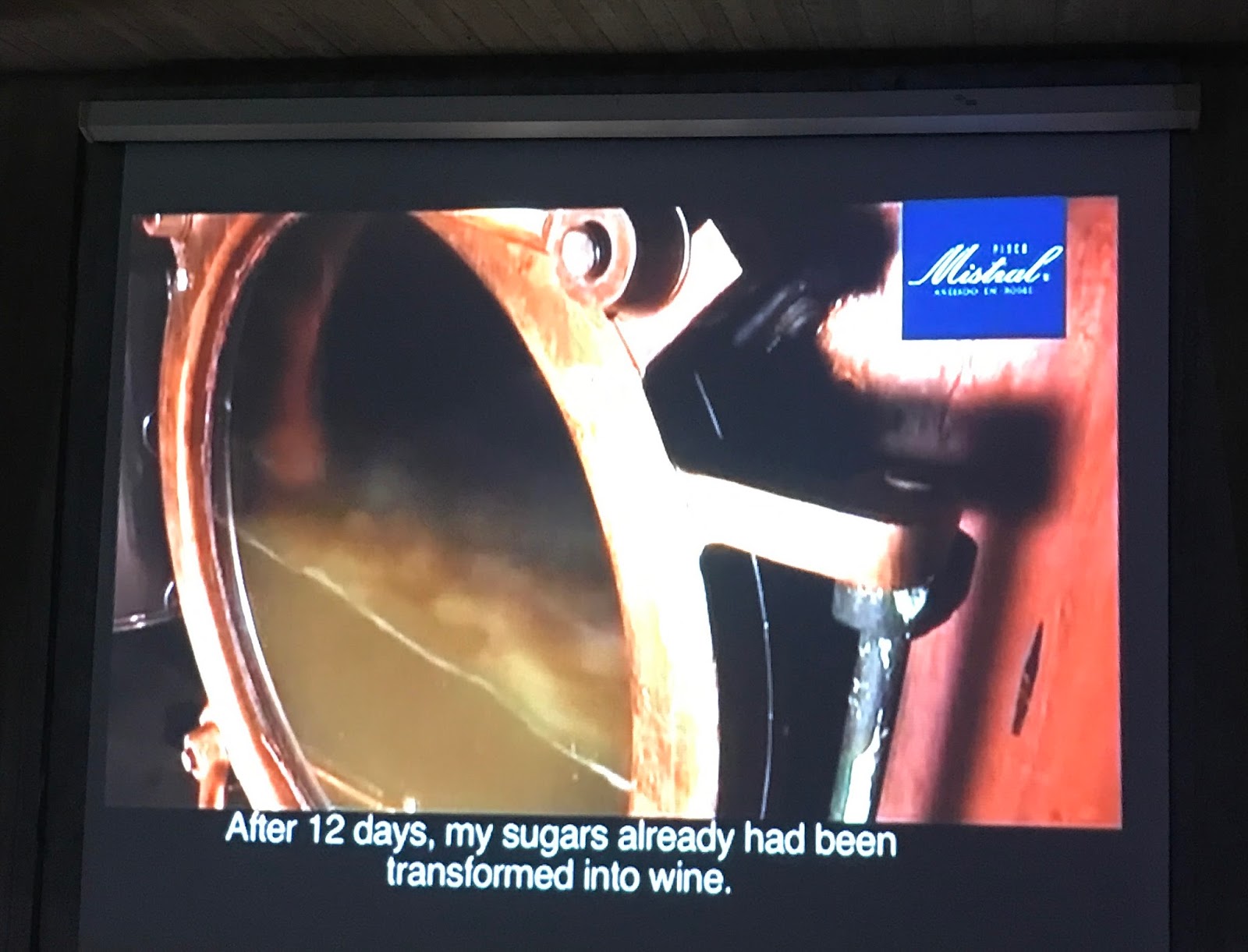
At the end of the tour, Carmen turned on an instructional film, which to my amusement was narrated in first-person Pisco. 
 After lunch, I stopped by the bar for my free Pisco sour.
There's another Pisco distillery either 2K or 4K from town, reportedly a better one. I asked Christin if there was a collectivo or bus. No, she said, your options are walk, bike, or hitchhike. I was tempted except for the heat. You can see why they say agua es vida ("water is life").
Back at the pool in front of my room, the bartender poured two samples from Nichos distillery. They were like grappa: guaranteed to kill germs for the rest of your life. Maybe I'll stick to wine and cocktails.

Monday, December 26, 2016

high desert days

I took the bus to Pisco Elqui, winding and climbing through the arid but fertile Elqui Valley.
Pisco Elqui is about 1200 meters above sea level. 
Except for the occasional stream and watered grapevines, it reminds me of Western Nevada. 


Huge, steep mountains. Mineral-rich soil and turquoise reservoirs.
There’s some argument over whether Peru or Chile lays claim to Pisco. I’m not taking sides. 
Chile has a large wine industry, mostly table wine exported to the US and Europe. I’ve been doing my part, drinking my share of Carmeniere.
Pisco Elqui itself is a tiny sunny haven. I’m staying at an eco-lodge in a room called Suspiro. There are ripe plums and apricots (damasco) and quinces on all the trees and a friendly bartender whipping up Pisco sours by the miniature pool. 

Next door at the Jardin Secreto, you can get your aura cleansed. Massajes are tempting.
The area is well known for astronomy, with several observatories. I can’t wait to see the stars tonight. My room has a big skylight.

This mural was in the bus station in Vicuña. I do not know why there's a UFO. (Edited: Elqui Valley has a reputation among latter day hippies, Ayurvedic practitioners, and seekers. Not my scene.)
I’d promised Doro I’d write about Gabriela Mistral, who came from this area and was the first Latin American to win the Nobel prize for Literature in 1945. 

She was a fascinating, complex woman who eventually left Chile for Europe and California. 

An early feminist icon. Beloved still.

Honored here on the 5000 peso note. 

I’ll definitely be reading her work and learning more about her the next few days. One friend explained she had to leave that small town and live abroad, because she was gay. 

Meanwhile here's a poem to get you started:

The treasure at the heart of the rose
is your own heart's treasure
Scatter it as the rose does:
your pain becomes hers to measure.
Scatter it in a song
or in one great love's desire.
Do not resist the rose
lest you burn in its fire.