Showing posts with label Pompeii. Show all posts

Saturday, December 22, 2018

Neopolitan


A visit to the land of the giants, aka Napoli's world famous Archaeology Museum.

When people write about Napoli, they say it is gritty and chaotic but has an undeniable energy. After Rome, I thought I understood what that meant, But Naples takes it to another level. Steep, dark, narrow, not very clean streets, with honking cars and scooters that obey no laws. I nearly got run over by a couple of asshole 6th graders. I called them names as they rode away laughing. Rome is money. Napoli, you take what you can get.

Fortunately I'm staying at a B&B tucked away behind a garden, through 3 gates. For breakfast, you can have orange juice squeezed from Dora's tree.

The windows on the boulevard are filled with sausages and marzipan and whole slaughtered lambs, including heads. I couldn't bear to take a photo.
I'd been warned about pickpockets on the subway and not wearing ostentatious jewelry. So I put on a pin with an angel, my faux Catholic garb, and set off for the anthropology museum.

Looking through a gate I saw this closed galleria. This is an old city with a lot of spunky history. It reminds me of New York in the late 70s and 80s.


Campania is famous for its precepes, elaborate holiday creches.  This one shows all the different classes, and shows people through different periods of history, including those on the right, restoring a villa in Pompeii (the artwork is upstairs in the museum).

On the ground floor, you can also visit the land of the giants. Magnificent marble from the 1st century BC to 2nd century AD.
 Love this guy's kilt. The barefoot Barbarian.
 The sarcophagus of a spouse

The museum's collection dates back to Bourbon king Charles II who brought many treasures from Rome and who began the excavations at Herculaneum and then Pompeii. The marble and mosaics are in exceptionally good condition. 
While some were painstakingly reassembled, like puzzle pieces, others appear to have been moved intact.

Remind me again why I didn't go sculpt marble in Pietra Santa with Great-Aunt Sylvia?
Curiously these mythical and in some cases historical giants are surrounded by an exhibit called Hercules alla Guerra (Hercules at war), which provides history of the location 75 years ago.

Naples and Salerno were bombarded by the allies in 1943. Naples was not ever considered truly conquered by the Nazis. In these appeals to the Italian popolo, British forces ask "why die for Hitler?" They were fascinating, although I wasn't sure I understood their relationship to the marbles.

This is an enormous piece of several men fighting a bull. The restoration was a complicated 3D puzzle. It stands at least 12 feet high.
The collection also includes rooms full of "gems" like miniature cameos with painstaking detail from the 2nd century AD.
 A larger bowl
But the real reason to come to this museum is it includes treasures from Pompei. The Bourbon King Charles moved whole walls to the city and this practice continued through the 19th century. The museum includes details on the natural dyes available for painting the brightly colored walls to paintings and mosaics that had to be thoughtfully put back together, without any guides.
They're remarkably joyful.

In yet another exhibition trying to make the past relevant, Dario Assisi and Riccardo M. Cipolla photoshopped images from the Pompeii collection onto contemporary pictures of Pompeii. And it works! 
 More on Fantasmi a Pompeii (Ghosts of Pompeii). And my post yesterday from Pompeii. 

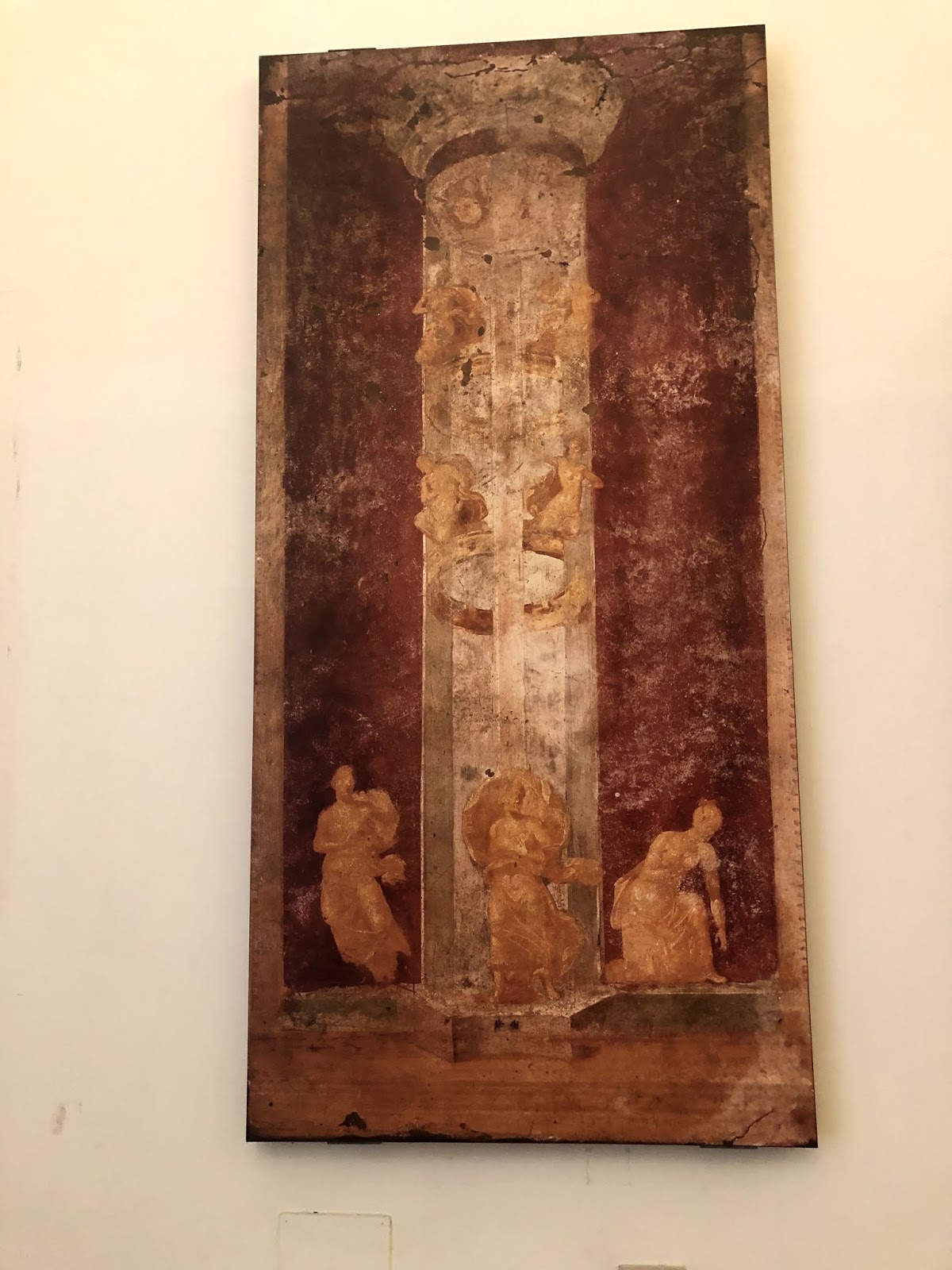
Winsome maidens
The red panels from a villa
 Bacchus in a grape costume!

These vessels are in an "Egyptian" style, which was all the rage. Egypt isn't that far from Napoli by boat.

This woman with the notebook and fashionable hairdo is known as Sappho. She's a popular archetype—not the Greek poet—and is on the cover of next year's pocket Pompeii calendar, which I picked up as a souvenir.
 A giant flute

A third juxtaposition, of sculpture visiting from Sichuan in a gorgeous 17th century palace. Truly misguided.

My last stop was the mosaics from Pompeii.


I knew about these because I overheard a guide on the site at Pompeii point out that floors we were taking pictures of were copies.

Four brick pillars, covered in mosaic patterns.
This full wall, depicting a painting of an historic battle, is estimated to have included one million tiles.
 Here's a fragment so you can get a better sense of the detail.
At first glance, some of the mosaics look like needlepoint.
Last but not least, sea creatures mosaic, including another octopus for Susan.


The last section had a warning on the door that you might be shocked by the sexual content. Predictably, it was full of enormous penises. I was more interested in these women.

I rushed off for a very late lunch to Gino e Toto's famed pizzeria. Everywhere in Naples is famous for pizza. But this is the pizza of pizzas. Everyone was there. They close between lunch and dinner, and I got my name in by 2:30, then waited nearly an hour in the street.

Service was appalling. They gave me the worst table by the door. A waiter stuffed a menu in my face then said I had one-minute to order before the kitchen closed. Asshole. Napoli is that kind of city.
A margherita runs 4 euros plus a cover charge for non-existent service. A glass of awful wine had cork in it. The verdict? Sweet sauce, generously applied. Sliced mozzarella balls with a splash of olive oil. But the crust was too soft and could have used salt. Slightly undercooked and served on a plastic plate that further moistens the bottom.


Pizza heaven? Not by a long shot. Grimaldi's and Lombardi's are both better, and nicer. Delfina too.
But we have a lot more pizza to eat before I leave town. I'll leave you with a view of the dessert case.


Friday, December 21, 2018

Pomp(eii) & Circumstance

What can I say about Pompeii that hasn't already been said? I fretted all week because the forecast was for rain, but it couldn't have been a more perfect day.
Zooming up the Amalfi coast, I was in Pompeii by 10.
I tried preparing for Pompeii—you can read hundreds of pages of intricate diagrams or download a podcast by Rick Steves—but as with Rome, found it overwhelming. So instead, I just wandered.
I would have picked up an audioguide or even a better brochures, but I wound up at a side entrance. It was fine. I barely went to any of the places on Mary Beard's list. Really, that's fine.
The basics: Pompeii had existed in this location by the sea for centuries; the Roman town was built in 37 to 27 BC.

In 62 AD, a big earthquake caused some damage, and then in 79 AD with only a little warning, nearby Mt Vesuvius erupted, covering the area in ash. Perhaps 20,000 were living there at the time.

Pompeii Scavi is an enormous site. It was rediscovered in the 16th century, but the most serious excavation happened beginning in 1858under the direction of Giuseppi Fiorelli.
If you visited Pompeii as a college student, you should go back and see how much more has been restored, now with better tools and techniques. (I had the same realization recently with Teotihuacan.)
The beauty of visiting Italia in December is there aren't any crowds, just a handful of tour groups and some families taking awful posed shots. So I was truly able to explore Pompeii at my own pace,
There's so much to see when you're not in a hurry. This centaur is a thing of beauty.
 The visitor center has movies showing a possible reconstruction.
You have a lot of freedom as far as which roads and houses to explore. Nothing stops you from touching the marble.
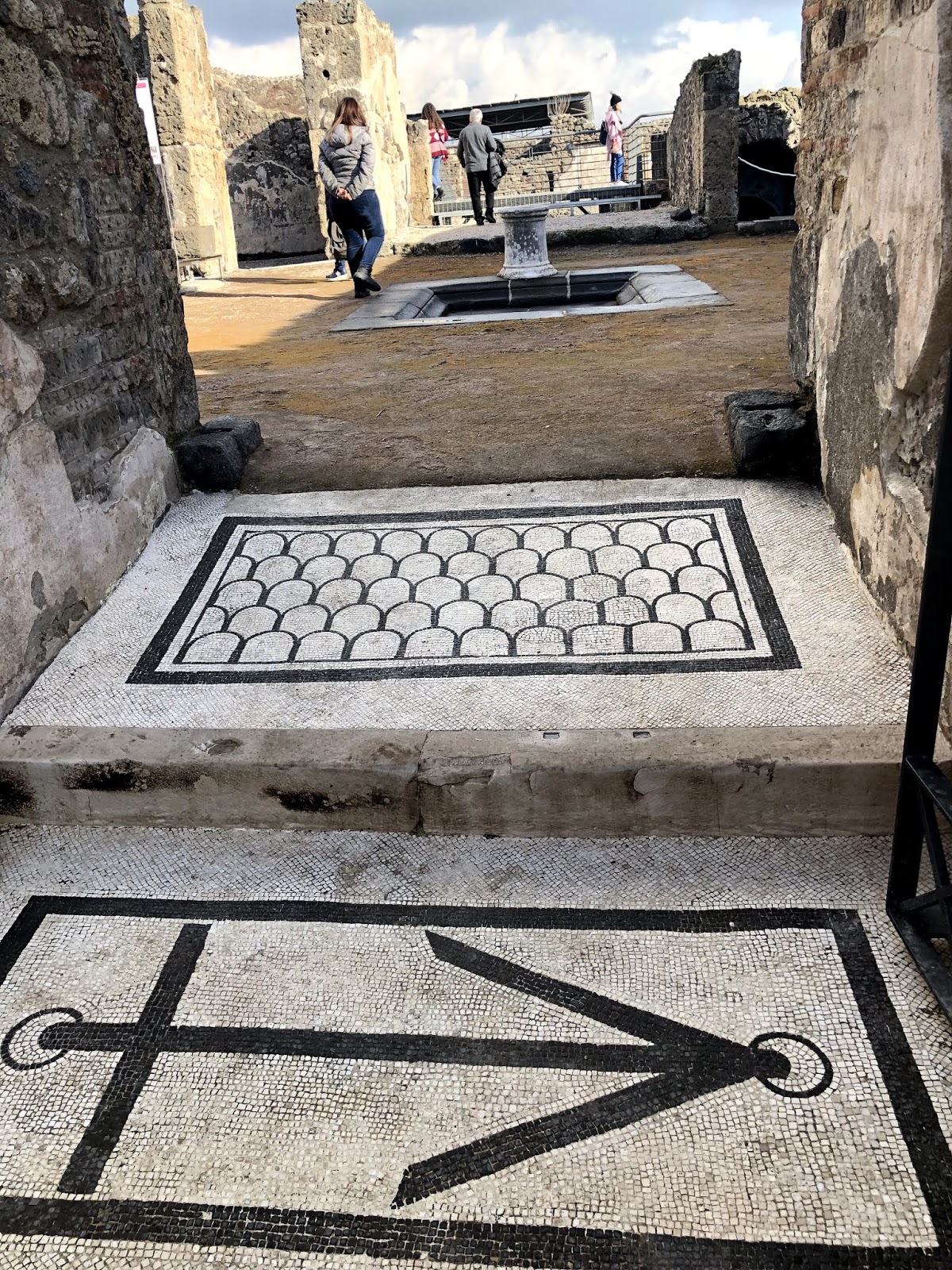
There are quite a few pretty mosaics, although I heard a guide say some of them are replicas.
The originals are at the Naples Archaeological museum, where I'm going tomorrow, right after I eat some Neapolitan pizza.

These bricks lie under the plaster of the pillars. I had no idea.
 A lot of pillars are in scaffolding that resembles an external cast.
 This warrior looks out toward the town of Pompei.


Inside the visitors center, they had an exhibit including cracked objects buried as a sacrifice.


In the Temple of Apollo, we find...Artemis, representing the moon.

And directly across from her is Apollo.

I admired his beautiful feet and arches. Apparently many people have rubbed them over the ages.

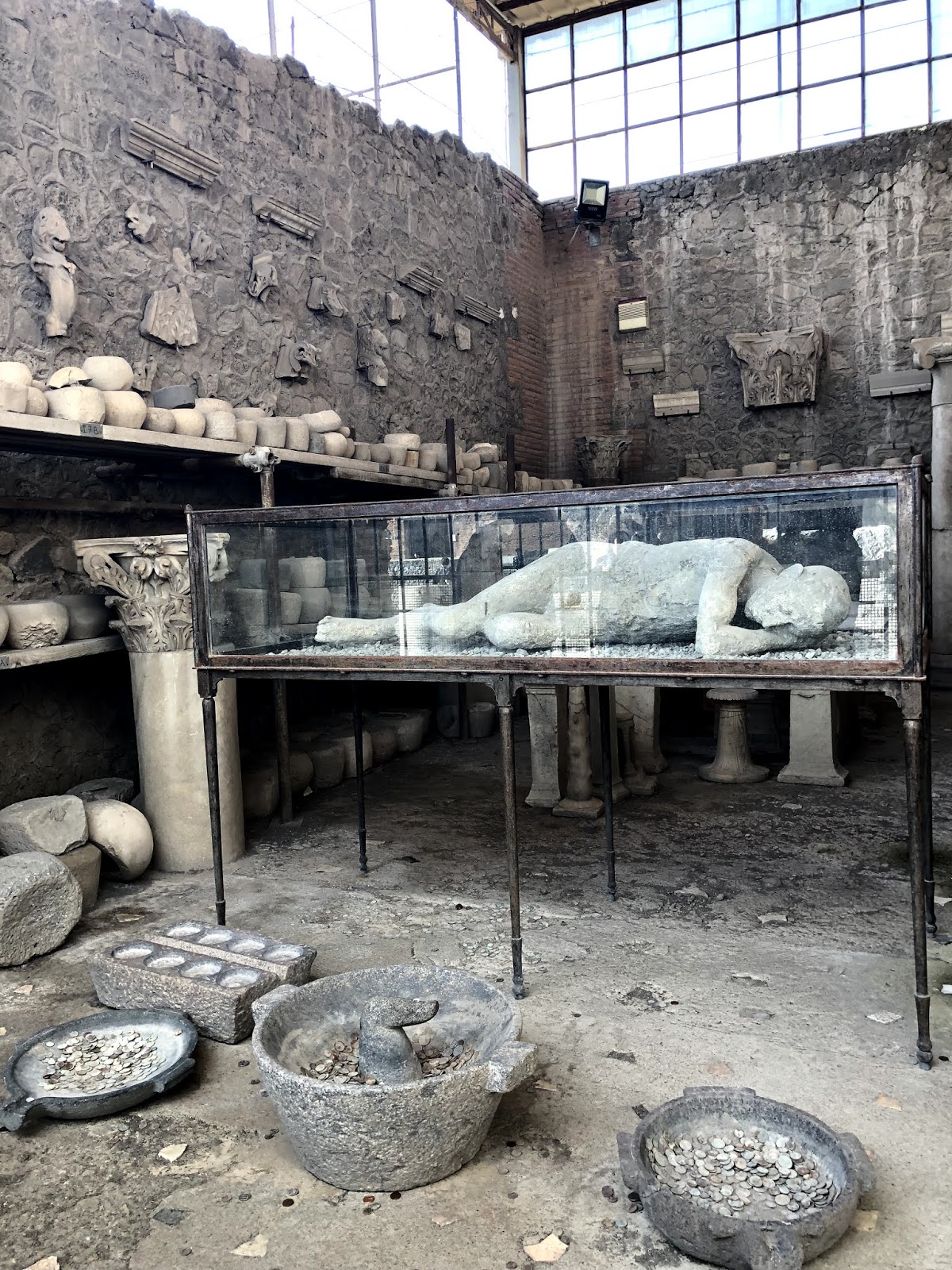
One of the most famous things at Pompeii is the casts made from people who perished there. This workshop is reassembling pots and gathering coins.


Not a sculpture--a terrified human being.
 The original LEGOs

The park is separated into ten sections, each representing a "neighborhood." The rich people had bigger estates and lived up the hill. Just like today.
Vesuvius is still visible in the distance.
A few more mosaics, at the entrance to the house.

One of my favorite houses had this secret garden.
Was this his house?
Uncovering the layers of materials

Rose is a rose is a rose.

 Brightly colored tile
A tiny status dancing in the fountain.

More casts of people who perished.

 This would be at home in the southwest. Note the intricate herringbone pattern.
 One of several amphitheaters. This is a small one.

A few brightly painted houses

 Elaborate gold leaf
 The colored washes give each home a different look.

This was my favorite room. Owned by a very rich man.


Last stop was the amphitheater, which predates the colosseum in Rome by 100 years. They had a Pink Floyd exhibit. 

 I'll bet the acoustics were great too.

As you might imagine, I'm all worn out from walking miles and miles (20,000 steps) on cobblestones. But not so worn out that I won't tell you about my splurgy lunch in a separate post.

Pompeii was the place I most wanted to explore on this trip. Every day has been filled with new wonders. But Pompeii does not disappoint.