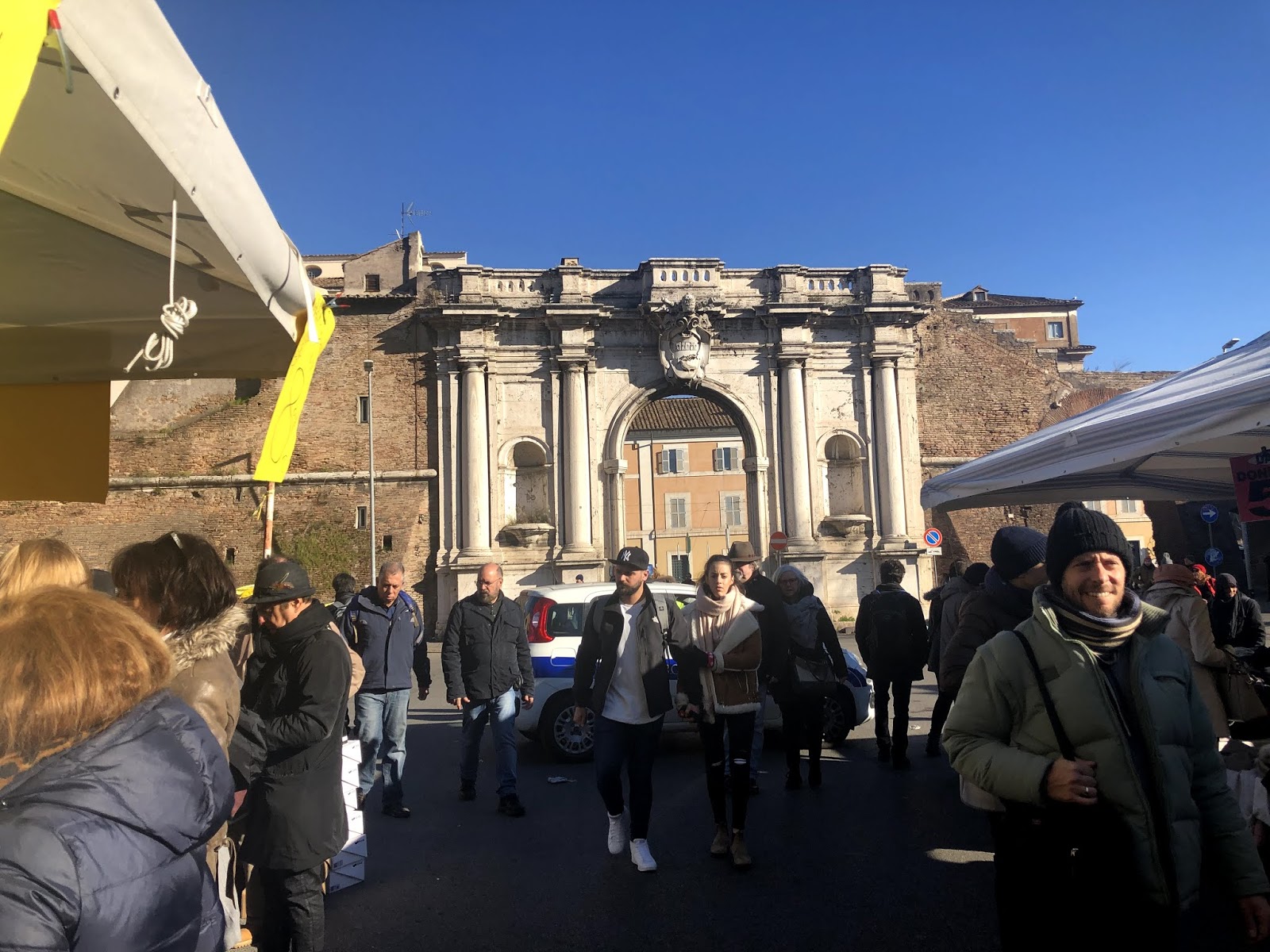
First stop was the flea market around the corner from the hotel in Trastevere. It was buzzing. You could buy just about anything for a euro or ten. Fuzzy scarves. Cheap undies. "Handmade" leather "made in Italia."

Tiny Roman truck. Ideal for pizza delivery, although no one delivers pizza here.


The first thing you spy at the edge of the ghetto is the ancient portico of Octavia, Mark Antony's often forgotten wife....built in the second century BC. She was also the sister of emperor Augustus.

It's all that's left of a temple and courtyard, though it's quite evocatively restored. It's below the current street level, at the level of the Tiber, and it was used as a fish market.

Nearby is Teatro Marcello. Unlike the Colosseo, it was only half a circle plus a stage. Actors, not gladiators.


The arch shows roughly where one of the walls of the Jewish Ghetto would have been. But we'll get to that in a few minutes.

First stop was the Jewish Museum, which is in the basement of this elaborate synagogue. The synagogue dates from 1904, after Jews were no longer required to live in the ghetto, and looks like an opera house. It is the only religious building in Rome with a square roof.

Surprisingly, it's filled with Art Nouveau touches.


It is still actively used by Rome's Jewish community, which today includes immigrants from countries like Libya and Tunisia.
I had booked a walking tour of the neighborhood through the Jewish Museum. The tour costs a very modest 8 euros but has a 3-person minimum. They don't really do anything to advertise it, so they offered that I could pay the whole 24 euros and have a private tour. I paid more than that yesterday at the Vatican, so I said yes. Much of what I learned today came from Patrick, my guide, who was born in Tunisia and told me a little about the North African Jewish diaspora.

I took a quick look at the museum's collection before the tour began. One of the oldest arons in Rome, built to face Jerusalem and hold a torah. This is from the early 16th century. (Jesse, do you think this is what the Ark is hiding?)

To recap Roman history: as many as a million people lived in Rome during the empire. But after the collapse in the 5th and 6th centuries, it was largely abandoned and depopulated. It would not thrive again until the Renaissance.
In 1492, Jews and Muslims were cast out of Spain. The early 16th century was marked by turmoil in Europe, as the Vatican tried to assert itself to fight off the Reformation.
Then Pope Paul IV in 1555 set forth a series of laws designed to get Roman Jews to convert to Catholicism. They could only occupy two professions, money lender and tailor. They could only have one synagogue and were surrounded by Catholic churches, and occasionally required to attend sermons (some wore earplugs). They had to move to one central location, a small area bounded by the river and prone to flooding, where they would be locked inside the gates at night. When they left the ghetto, they had to wear yellow--for women, the same color as prostitutes. They could not own property, and with so many people packed together in a small place, epidemics quickly spread.
Jews continued to be confined to the ghetto and various restrictions on and off through 1870 when Italy became a unified nation, and Rome was no longer run by the Pope. The walls of the ghetto were torn down in 1888, along with many of the older buildings representing the poverty of the previous era.
Jews continued to be confined to the ghetto and various restrictions on and off through 1870 when Italy became a unified nation, and Rome was no longer run by the Pope. The walls of the ghetto were torn down in 1888, along with many of the older buildings representing the poverty of the previous era.
And yet, as Patrick told me, the Church wanted to convert the Jews, not kill them. If you were wealthy, perhaps you could leave Rome. But where was there to go that was safer?

Hipster rabbi would be right at home in today's trendy Jewish Ghetto.

Some of the collection is quite old. There was a chair used for circumcisions; I skipped that.

But I liked these coins, which were given to the poor for sustenance. One coin was worth a chicken.

One interesting section of the collection was about Jews from Libya, who came in the late 1960s to Italy after backlash from the six-day war in Israel. (Libya was an Italian colony.)


Some of the lovely architecture across from the Synagogue.

I commented to Patrick on the layers of history walking through every street in Rome. He laughed. "Rome is like lasagna," he said. (Pasta is life, I thought.)

The Jewish community survived much of World War II in Rome; in fact, the liquidation of the ghetto in October 1943, in front of the portico of Octavia, happened after the allies were winning. Mussolini had surrendered. But the Nazis quickly occupied Rome and told the local Jews they had to raise a small fortune to avoid being sent to concentration camps. On October 11, they held a 5 am selection, and 2000 men, women, and children were sent to camps in Poland and Germany. Only 16 of those people survived the war.
Many Roman Jews were not rounded up. Italians didn't support the Nazis, and some Catholics hid their neighbors. This stumbling stones project was begun a few years ago by German artist Gunter Demnig, who has documented Jews who were killed by the Nazis, placing small reminders of where they lived. Of the entire Sabatello family, only Leone survived Auschwitz. The goal of the project, in a very modest way, is to call attention to who lived here, so that they are not forgotten.

The turtles on this fountain were made by Bernini. It's said they represented the Jews of the Ghetto, carrying their homes with them on their backs.

Patrick said this building was one of the first built in the ghetto in Renaissance Rome. On the corner is a famous family bakery. I stood in line and bought a truly ugly fruitcake bar with burnt almonds and bright green candied fruit. Pretty sure I was overcharged, but it was strangely tasty.

And then it was time to explore. Free museums on the 1st Sunday of the month! Too bad my brain was already full.
I found my way toward the Pantheon and discovered the famous Bernini elephant and obelisk.


Seriously, who wouldn't want to live here if you were a cat?
The Torre Argentine organization raises money for spaying, immunizing, and releasing feral cats. Some are adoptable; I met a black cat who was ready to come home with me. Others are brought inside and kept indoors for treatment; some of the older cats are blind.

A few of the active cats are three legged.

One final Roman dish: puntarelle marinated in olive oil and anchovies. Puntarelle is a chicory, related to artichokes. I've tried making it myself, when I got some from Mariquita, and it tasted like bitter dirt.

I also had a big bowl of pasta alla carbonara, just what I needed to send me on my way.

The sun went down while I was dining at the gallery cafe. My feet ached! (Only 6.5 miles on uneven cobblestones today.)


It's been a fantastic visit to Rome, Naples and Salerno, and Sicily. So many doorways. I've learned so much since I arrived, including how to pass for Italian. Perhaps most rewarding, I discovered that the old school Italian restaurants and culture of my childhood in New York still exist here in Italy.
For all its sophistication and prosperity, for all the extraordinary painting and sculpture and architecture and history, proud Romans and Sicilians and Campanians mostly lack pretense. The past is still very much present.

So many layers of history everywhere you look. Lasagna.

Until next time: arrivederci, Roma!
Arrivederci, Roma!